
200 Endgame Puzzlesto win your endings.
10 lessons · 200 positions · 800–1800
Many club games are decided in the ending, often by a single move. This workbook teaches the endings you will meet: each of its ten chapters opens with a two-page lesson, the rule to remember and two positions to know, then gives you twenty positions from real games to solve with a pencil. Every solution is explained at the back.
One payment, on Stripe’s secure page: card, Apple Pay, Google Pay or PayPal. The PDF is emailed to you right after payment.
- A4 PDF to print, 138 pages
- Ten lessons, 200 positions from real games
- Every solution explained, every position checked
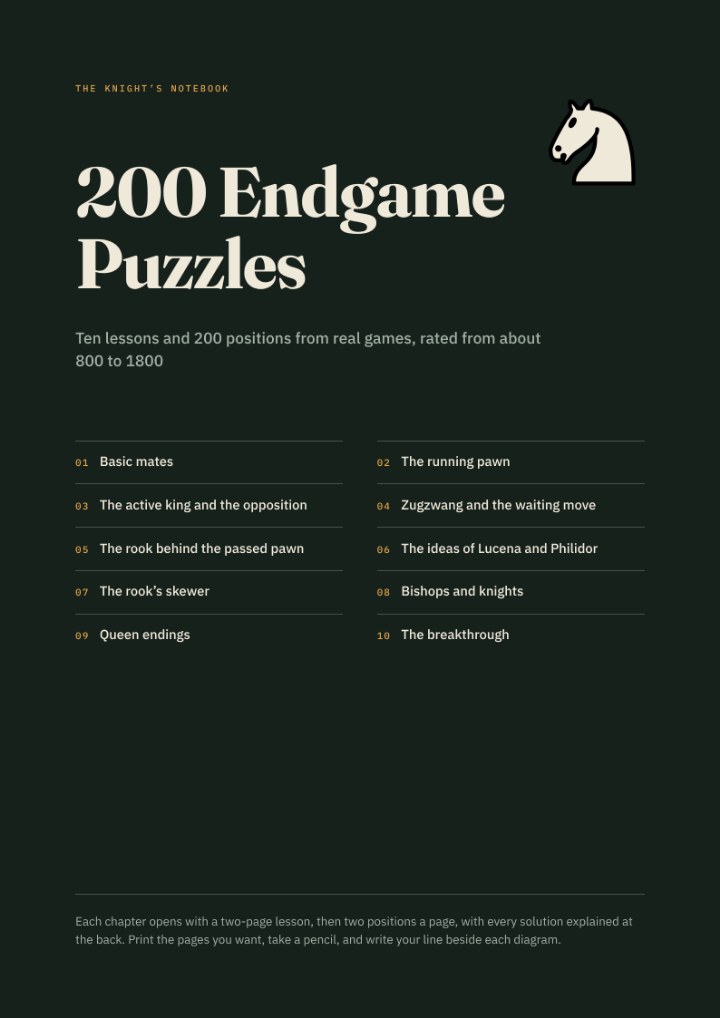
From the basic mates to the breakthrough.
Each chapter opens with a two-page lesson, then twenty positions, from the easiest to the hardest. Here is the rule each lesson teaches, and the ratings of its positions.
- 01Basic matesDrive the king to the edge with your piece, bring your own king up, then mate on the edge.814–1401
- 02The running pawnDraw the square from the pawn to the last rank: if the enemy king can step into it, it catches the pawn.817–1512
- 03The active king and the oppositionBring your king in front of the pawn, onto a key square, before you push it.908–1588
- 04Zugzwang and the waiting moveIf the position wins with the opponent to move, do not change it: lose a move, with a spare pawn step or a king triangle.1008–1711
- 05The rook behind the passed pawnPut your rook behind passed pawns, your own and the enemy’s: that is Tarrasch’s rule.908–1588
- 06The ideas of Lucena and PhilidorAs in Lucena’s position, check to drive the enemy king away from what it guards, and put your rook in the way of the enemy rook.1108–1806
- 07The rook’s skewerBefore every rook move, look for a king and a rook on the same rank or file.812–1609
- 08Bishops and knightsCount how fast your passed pawn queens and what can still stop it.891–1712
- 09Queen endingsBefore every check, look at the line behind the enemy king: a queen there can be lost.1008–1678
- 10The breakthroughBefore you break through, count: the new passed pawn must queen before the enemy king or pawns can stop it.1299–1797
Pages from the book, ready to print.
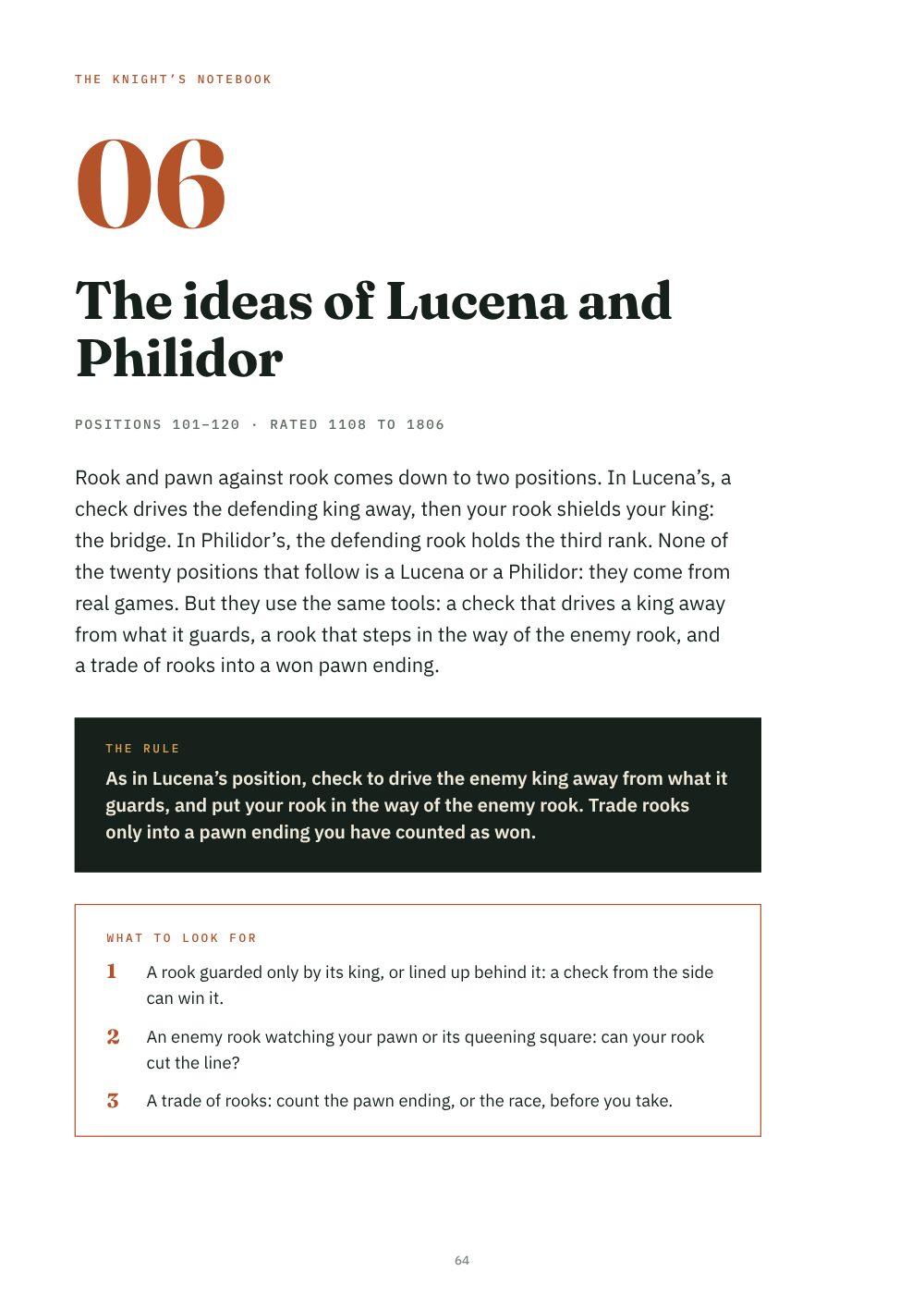
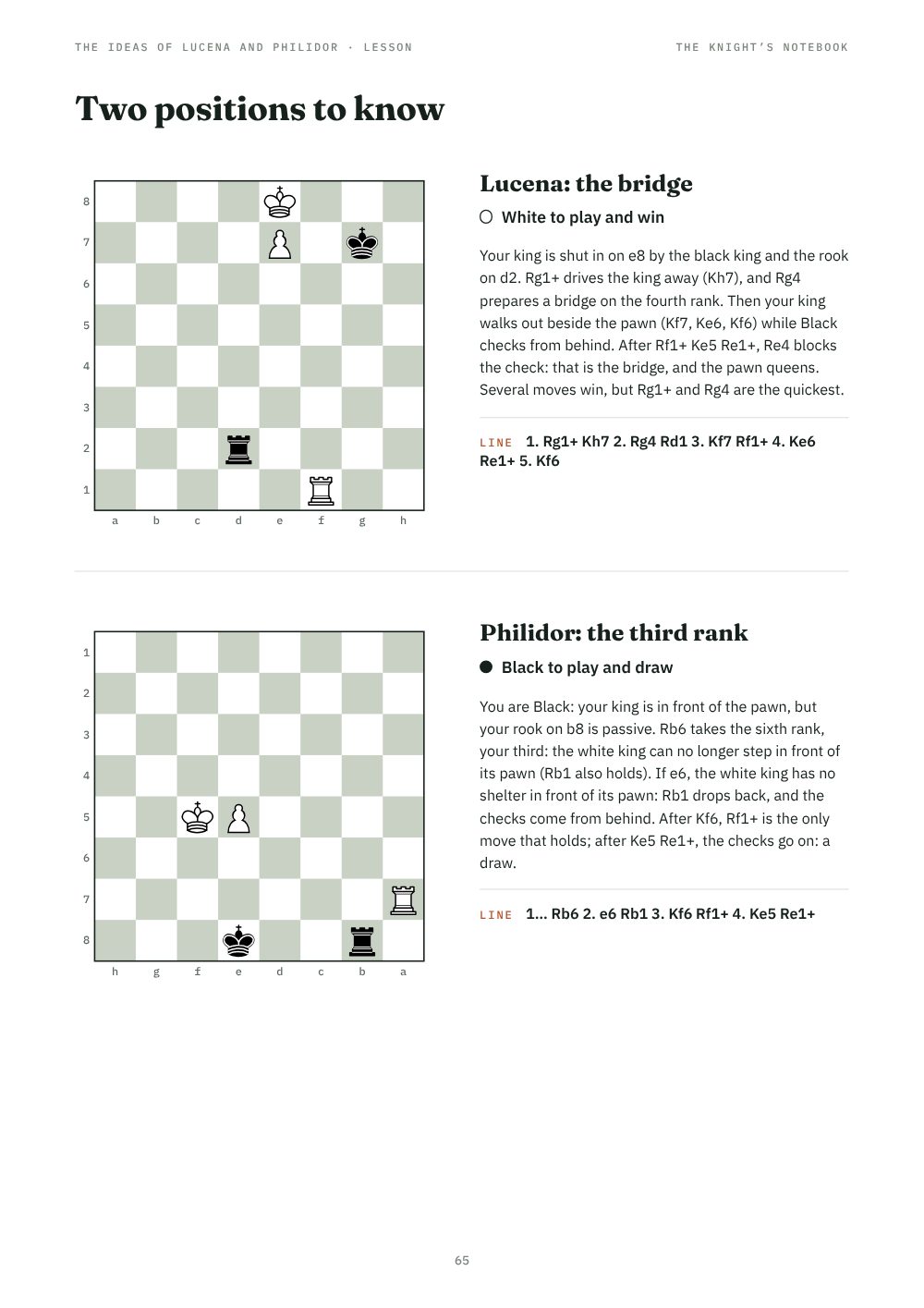
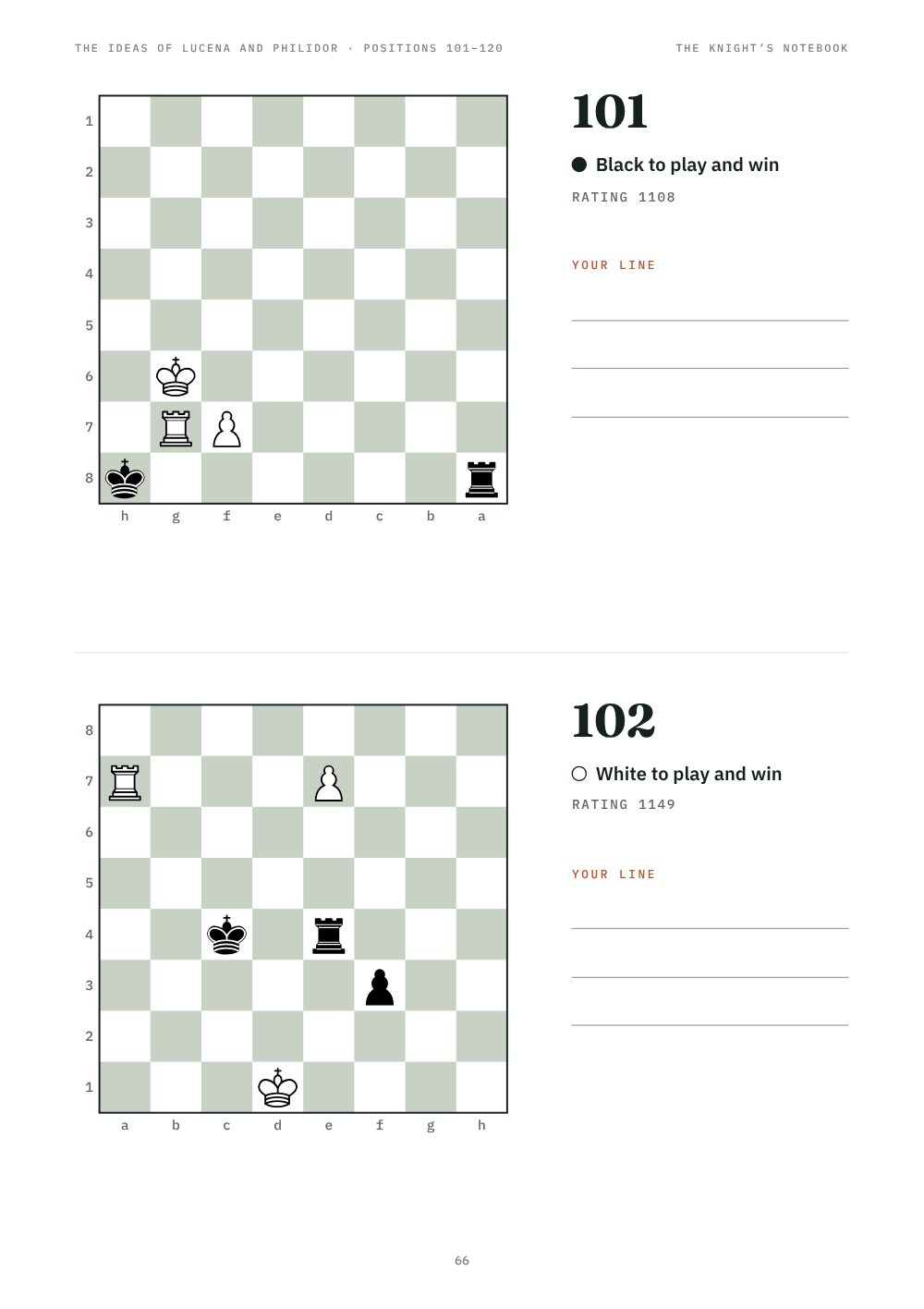
A pencil, the page, then the answer.
Read the lesson
Two pages open each chapter: the rule to remember, three signals to look for and two positions every club player should know.
Print the positions
Two positions a page, on A4. Print one chapter at a time, or the whole book.
Write your line
Find the move that wins and the replies you expect, and write them beside the diagram. Commit before you check.
Check at the back
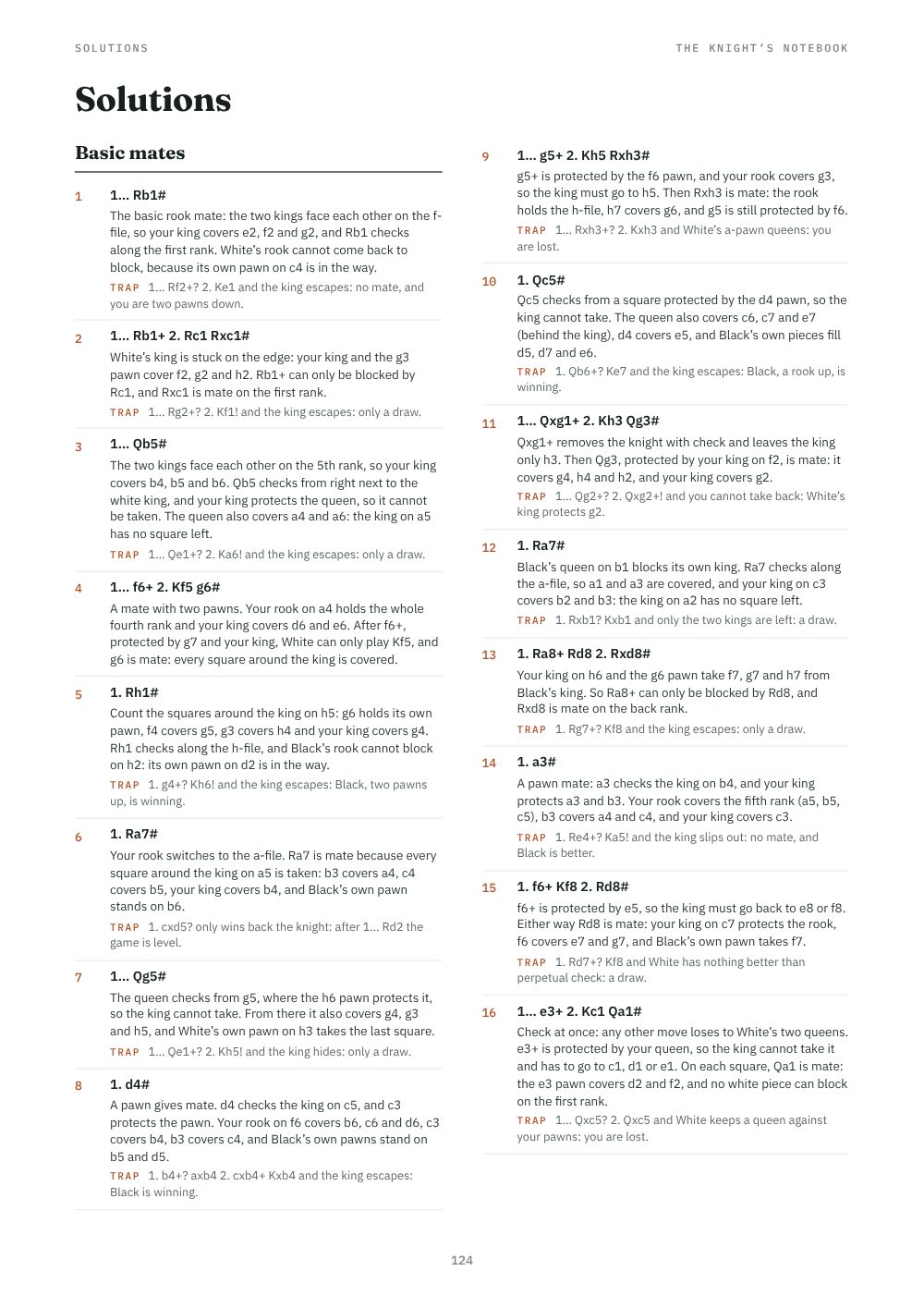
Each solution gives the line and the idea in a sentence or two; 199 of them also show the tempting move that fails.
Endings from real games, checked move by move.
From real games
The 200 positions come from games played on Lichess, through its puzzle database (public domain): the endings club players actually reach, not composed studies.
The move that wins
In an ending, the move that wins and the one that only draws often look alike. In chapters 2 to 10, every position was checked with the Syzygy endgame tables (seven pieces or fewer) or with Stockfish: the solution is the only move that wins. In chapter 1, every mate is played out to the end.
Rated by players
The rating beside each diagram comes from Lichess, where each position has been tried at least 800 times: a position rated 1200 is solved about half the time by players rated 1200 there.
Club players from about 800 to 1800.
- Club players from about 800 to 1800 Elo. Many games are decided in the ending, and often by a single move: the king that steps up, the rook that goes behind the pawn.
- You only need the rules and basic tactics: the lessons give you the rest, from the rule of the square to Lucena and Philidor.
- Solved 300 Chess Puzzles or 150 Chess Puzzles? These 200 positions are new: none of them is in the site’s other books.
Your questions, answered.
Is it right for my level?
Yes, if you play from about 800 to 1800 Elo. In each chapter the positions go from the easiest to the hardest, with their rating beside the diagram, and the lesson comes first. You only need the rules and basic tactics: the rules of the endings, from the square to Lucena and Philidor, are in the lessons.
What is in it?
An A4 PDF of 138 pages, to print. Ten chapters, each opened by a two-page lesson: the rule to remember, what to look for and two positions to know. Then twenty positions from real games, two a page with room to write your line: 200 in all. Every solution is explained at the back, from page 124.
How do you know the solutions are right?
Every line was played through, move by move. In chapters 2 to 10, each position was checked with the Syzygy endgame tables, which know the exact result of every position with seven pieces or fewer, or beyond that with the Stockfish engine, and kept only if its solution is the only move that wins. In chapter 1, the basic mates, each solution is a mate in one to three moves, played out to the mate. 199 of the 200 solutions also show the tempting move that fails, and why.
Where do the positions come from?
From real games played on Lichess, through its puzzle database (public domain): you practise the endings club players actually reach. Each has been tried by many players, so its rating is measured, not guessed. The positions of the lessons, such as Lucena’s and Philidor’s, are the classic positions of endgame theory, set up for the book and checked with the tables.
Are these positions in 300 Chess Puzzles?
No. None of these 200 positions is in 300 Chess Puzzles, 150 Chess Puzzles, The 30-Day Chess Challenge or the opening books: you will not meet one you have already solved. The 300 trains tactics; this book trains the endings.
Can I print it more than once?
As often as you like: the whole book or one chapter at a time. The pages are A4, ready to print; on US Letter paper, choose “Fit to page”.
When will I get it?
Right away. The moment you pay, an email brings you the download link, usually within a few minutes, and it keeps working whenever you want to download the book again. Anything wrong? Check your spam folder or write to us at hello@knightsnotebook.com: we will send it again.
Is payment secure?
Yes. You pay by card or Apple Pay through Stripe, one of the most widely used payment platforms in the world, and other options may be offered depending on your country. We never see your card details. It is a single payment, with no subscription.
How is it different from the monthly notebook?
This book teaches the endings, one kind at a time, with a lesson before each chapter: to keep and come back to. The monthly notebook is your regular training: every month, sixty new positions at your level, across all the themes. The two go together.
Which notation, which languages?
Algebraic notation with the English piece letters: K, Q, R, B, N. The book also comes in French, German, Italian, Spanish and Norwegian, each edition with the piece letters of its language.
Win the next ending you reach.
Ten lessons and 200 positions from real games, in a PDF to print.
Finished the book? Keep going with the monthly notebook: sixty new positions at your level, every month.